
Haverhill City Directory Holdings by Year
The Massachusetts State Library catalog is the clearest starting point for Haverhill city directories. It lists named Haverhill issues from 1857 through 1969, with additional suburban and vicinity issues. Those catalog entries establish that a run exists, but the catalog notation should be checked before calling an item microfilm or assuming it can be read online. Haverhill Public Library adds local history material that helps interpret the listings, while the Senter archive supplies a public digital layer for people, places, and events.
| Collection | Years | Where Held | Access |
|---|---|---|---|
| Haverhill city-directory catalog run | 1857–1969 listed issues | Massachusetts State Library | Catalog first, then confirm item format and reading access |
| Haverhill voting-list run | 1902; 1924; 1939–1950; later listed issues through 1990 | Massachusetts State Library | Historical companion source |
| HPL local-history and genealogy collections | Varies by collection | Haverhill Public Library | Physical access is currently affected by renovation |
| HPL local-history vertical file | 1705–1994 | Haverhill Public Library | Finding aid, targeted staff request, or future onsite access |
The listed run has gaps and format changes. Preserve the exact year in your notes, since an absent name can mean a skipped edition, a changed spelling, an unlisted household, or a move. The State Library directory and voting-list catalog is the source for the year ranges, not a searchable name database.
Haverhill City Directories at the Library
The Haverhill Public Library Special Collections describes a practical research stack: the Haverhill Collection, the Pecker Collection of Regional History and Genealogy, the Whittier collection, newspapers, yearbooks, rare shoe-industry publications, biographical files, maps, and vertical files. A directory gives the date and street reference. A yearbook can pin down a school year, a clipping can identify a family event, and a map can make an old street label easier to place. The library’s local sources are especially helpful when a surname is common.
The Haverhill Public Library Special Collections page is the source for the library’s historical and genealogy collections.
Because the physical collection is unavailable or offsite during Phase I of the 2026 renovation, use a focused request or confirm current access before planning an in-person visit. The regular library address is 99 Main Street, Haverhill, MA, and Special Collections lists 978-373-1586 ext. 642 for collection questions.
Note: Record the edition, publisher, page, and access date because the Haverhill collection’s physical location and availability can change during renovation.
Senter Preserves Haverhill Directory Context Online
When a shelf volume is not available, the Senter Digital Archive remains an online route to thousands of digitized Haverhill images of people, places, and events. It is not a replacement for every city directory volume. Instead, use it to test a name, landmark, organization, or event that appears in a city-directory entry. A photograph caption, local event record, or yearbook image can provide a date and context worth following in the State Library run or the library’s research service.
The Senter Digital Archive is Haverhill’s available online local-history collection while physical Special Collections material is offsite.
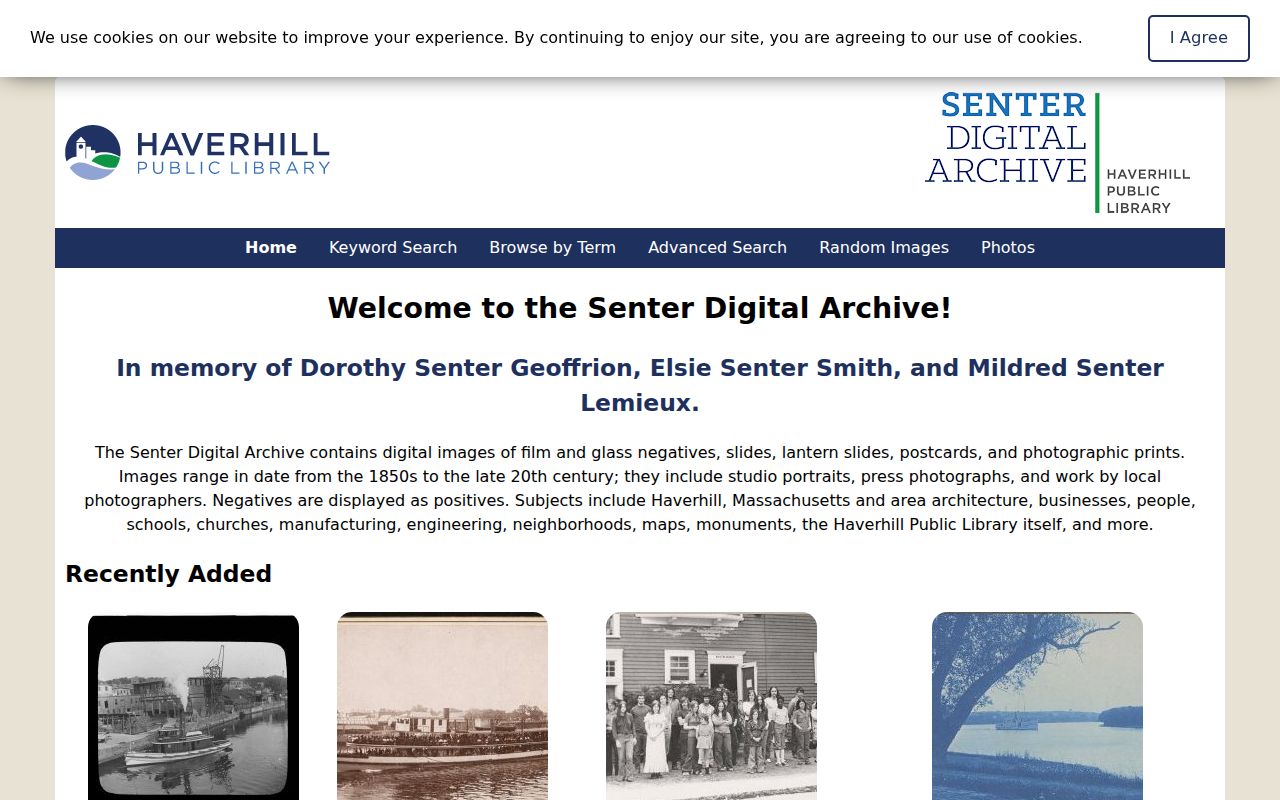
Save the item title and link with the directory citation. That small record of provenance makes it easier to separate a dated historical reference from a modern search result.
Decode a Haverhill City Directory Entry
A city directory entry should be transcribed as printed before it is interpreted. The Haverhill research inventory identifies a surname, given name or initials, street address, and sometimes a business or occupation line as the core elements. Some editions add a telephone, ward, cross-street, or a short residence or business notation. Details vary by publisher and year, so do not assign a fixed meaning to a letter until the edition’s own abbreviation list has been checked.
| Name form | Copy surname, initials, spelling, and punctuation exactly as printed. |
|---|---|
| Street reference | Keep the number, street spelling, apartment notation, and any cross-street or ward clue. |
| Business line | Use it as a dated identity clue, then confirm it with a city report, newspaper, or filing where needed. |
| Shared address | Several entries at one number can suggest a household or building connection, but conventions change by edition. |
| Change mark | Keep any removal, absence, residence, or business notation rather than silently expanding it. |
- Criss-cross directory
- A directory portion arranged by street and number rather than by surname, when a volume includes one.
- Householder index
- A name arrangement intended to identify the listed household contact or address reference, not a complete roster of everyone present.
- Abbreviation key
- The publisher’s explanation of short marks and labels, usually near the front matter and essential before transcribing them.
Haverhill City Directories Between Censuses
Directories fill the years between census releases. Federal census records through 1950 are available for public research under the Census Bureau’s 72-year rule, so a Haverhill directory can narrow the year and address before a census image is checked. The State Library’s directory sequence is particularly dense from 1894 through 1904, which makes it useful for following a household through several annual snapshots rather than jumping straight from one decennial census to another.
| 1857 | First Haverhill directory year listed in the State Library catalog. |
|---|---|
| 1894–1904 | Continuous cataloged sequence useful for year-by-year comparison. |
| 1902 onward | Selected Haverhill voting lists offer a separate civic cross-check. |
| 1969 | Latest standard Haverhill city-directory issue listed in the catalog. |
| 1973 | Haverhill and vicinity PSP Blue Book listed as a companion issue. |
A census image and a directory entry can disagree without either being wrong. One is tied to an enumeration date; the other is tied to a publisher’s collection and printing cycle. Cite both dates.
Haverhill City Directory Voting Cross-Checks
Historical voting lists are useful when a city directory leaves a gap. The State Library catalog identifies Haverhill voting-list years including 1902, 1924, 1939 through 1950, 1952 through 1958, and selected later years. They answer a civic-registration question, not every question about a household. A difference between the two records may reflect timing, an address move, a change in eligibility, or a publisher’s listing practice.
For a living individual, the Massachusetts Voter Registration Search is an individual status form, not a historical browseable directory. Haverhill’s completed street list and local voter-list route remain with the City Clerk and have protected fields.
Haverhill City Directories and Deed Dates
A Haverhill city directory can supply an address, while the Essex South Registry of Deeds supplies recorded-land context. The Registry’s image run begins in 1640, its electronic index begins in 1951, and its street search has a later 1995 starting point. A name on a deed may be a grantor, grantee, trustee, executor, or another party. Compare the role and recording date before treating it as an ownership conclusion.
For a present-day parcel question, the address records on the Haverhill By Street directory are the more direct starting point. Historical directory work is strongest when it stays focused on the dated household trail.
Haverhill Directory Access: An Insider Tip
HPL’s physical Special Collections closure does not mean the historical trail ends. The 2026 building-project update says the collection is unavailable until further notice, while Senter remains accessible online. Start with the digitized archive, the State Library catalog, and a precise library request. The HPL research service asks for a person, place, event, date, address, and associated names, which is far more useful than sending a broad family surname alone.
The request service also asks for an exact date of death for obituary work. Not every death received a newspaper notice, so a no-result should lead to a city death record, State Library material, or another dated source rather than a firm conclusion.
Trace a Haverhill City Directory Household
Use a Haverhill city directory as a sequence, not a one-line answer. Start with the earliest confirmed surname and address, then move through the closest available editions. Record what changed and what did not. The 1893 Library of Congress Sanborn atlas, with 47 sheets covering Haverhill and named neighboring places, can help explain why an older address is described with a wider place label. It cannot identify every person by itself.
- Find the first confirmed directory entry and copy its spelling, address, edition, and page.
- Check the next available Haverhill issue for the same surname, initials, and street number.
- Read any street or classified portion included in that particular volume before drawing a household conclusion.
- Pair the dated entries with an available census image, voting list, deed, newspaper, or vital-record route.
- End the note with the source date and an unresolved question, rather than guessing why a name disappears.
A name can vanish because of a move, a changed entry style, a skipped issue, or death. The HPL research-service route and the City Clerk’s vital-record channels are appropriate follow-ups when the date and jurisdiction are known.
Haverhill City Directory Clues Need Two Sources
The Haverhill record trail spans Pentucket-era material, town records, and city-era collections because Haverhill became a city in 1870. The Great Conflagration occurred around Washington Street on February 17–18, 1882, but no official source found evidence that it destroyed a particular municipal record series. Treat the event as a reason to compare archive descriptions, maps, directories, newspapers, and deeds, not as an explanation for any missing entry.
Buttonwoods, the Haverhill Historical Society, adds artifacts, historic-house context, and finding-aid material. Its collection and the HPL vertical files may provide the second source that a directory line needs. Check access and appointment needs with Buttonwoods before a visit.